
Sex Offender Checks in Hart County
The Georgia Sex Offender Registry, maintained by the GBI and GCIC, is the main public search for Hart County sex offender records. It accepts county and place filters after a conditions screen and CAPTCHA. The Hart County Sheriff's Office also provides a Sex Offenders channel and is the local office responsible for registration reports and verification.
Use the live state record first, but treat it as a point-in-time report. GBI says the data comes from other agencies and changes often. When a move, status, or registration date seems recent, call the sheriff at 706-376-3114 instead of drawing a firm conclusion from an older result.
The access chain has three official layers. GBI publishes the statewide profile, Hart County Sheriff supplies and verifies the local registration facts, and NSOPW reaches beyond Georgia. None is a general criminal-history search. A registry entry addresses a statutory registration duty tied to a qualifying conviction; it does not report every arrest, charge, or court case linked to a name.
Filter Hart County Registry Results
A county filter is more reliable than a broad web search because it keeps the request inside the official registry and limits results to the jurisdiction selected. Begin with Hart County, then add a city, ZIP code, or name only when that detail is known. Spelling matters, and aliases can change which profile appears.
A blank result is not proof that no qualifying record exists. The input may be wrong, a change may still be moving through the reporting chain, or the person may be registered in another state. Check the search terms, try the official national layer, and direct a specific concern to law enforcement.
Geographic searches also depend on the address entered after the gate. Use the live controls shown by GBI rather than assuming a radius that the portal may not offer at that moment. If a street lies near a county line, repeat the search with the neighboring county or use the national tool. For Hart County, this prevents the county dropdown from being mistaken for a fixed mile radius.
How to Search the Georgia Sex Offender Registry
The Georgia registry is free, but access begins with its conditions-of-use gate. Read that notice. It explains that information is supplied by other agencies, changes continuously, and should be verified with the responsible sheriff. The portal also requires a CAPTCHA before the full search controls appear.
- Open the GBI registry, read the conditions, and select “I agree.”
- Enter the displayed code or use the audio/change-code controls, then continue.
- Choose Hart County and add a known name, city, ZIP, type, or status filter.
- Open a possible profile and compare several identifiers before treating it as a match.
| Field Label | Type | Required | Notes |
|---|---|---|---|
| First / Last Name | Text | No | Exact spelling affects matches |
| Offender Type / Status | Selection | No | Use the options shown in the live portal |
| City / ZIP | Text or selection | No | Narrows the geographic area |
| County | Dropdown | No | Select Hart |
| Conditions / Code | Buttons and CAPTCHA | Yes | Required before the search form |
The field labels beyond the CAPTCHA can change, so the live form controls the search. Do not invent a one-mile, two-mile, or five-mile range when the current interface does not display one. Keep a note of the spelling, county, city, ZIP, status filter, and search time. That record makes it easier to correct an input error or explain a concern to the sheriff.
The official Georgia Sex Offender Registry search screen shows the conditions gate and public access route assigned to Hart County searches.
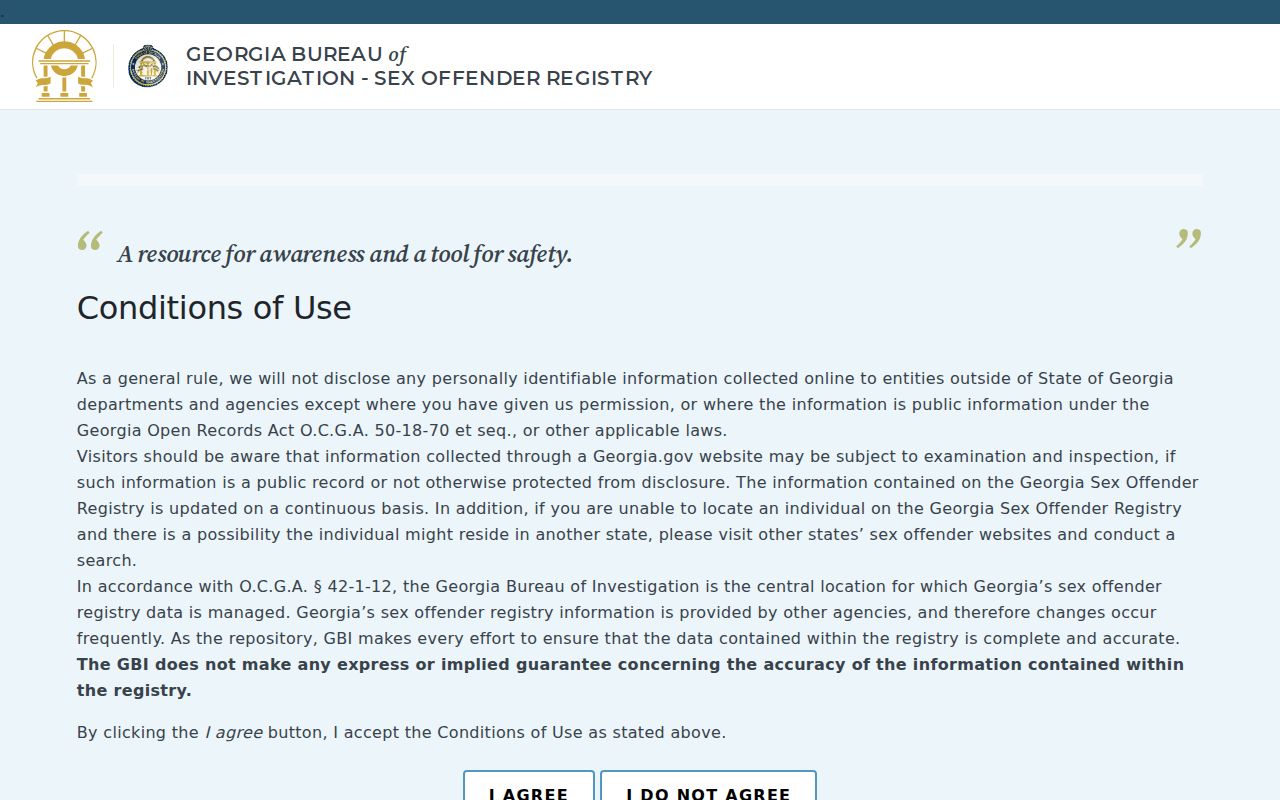
This state interface is the correct starting point for a Georgia profile, county filter, and current registry status.
Hart County Cross-State Registry Search
Hart County sits close to South Carolina, so a Georgia-only search can be too narrow for community awareness near the state line. The U.S. Department of Justice National Sex Offender Public Website searches participating state, territorial, and tribal registries through one official service.
The national search is a supplement, not a replacement for the GBI profile. Use NSOPW when a person may have registered elsewhere or an address search crosses a border. Return to Georgia's registry for the current Georgia record, and ask the Hart County Sheriff about local verification.
The official NSOPW interface is shown below as the cross-state layer assigned to this page.
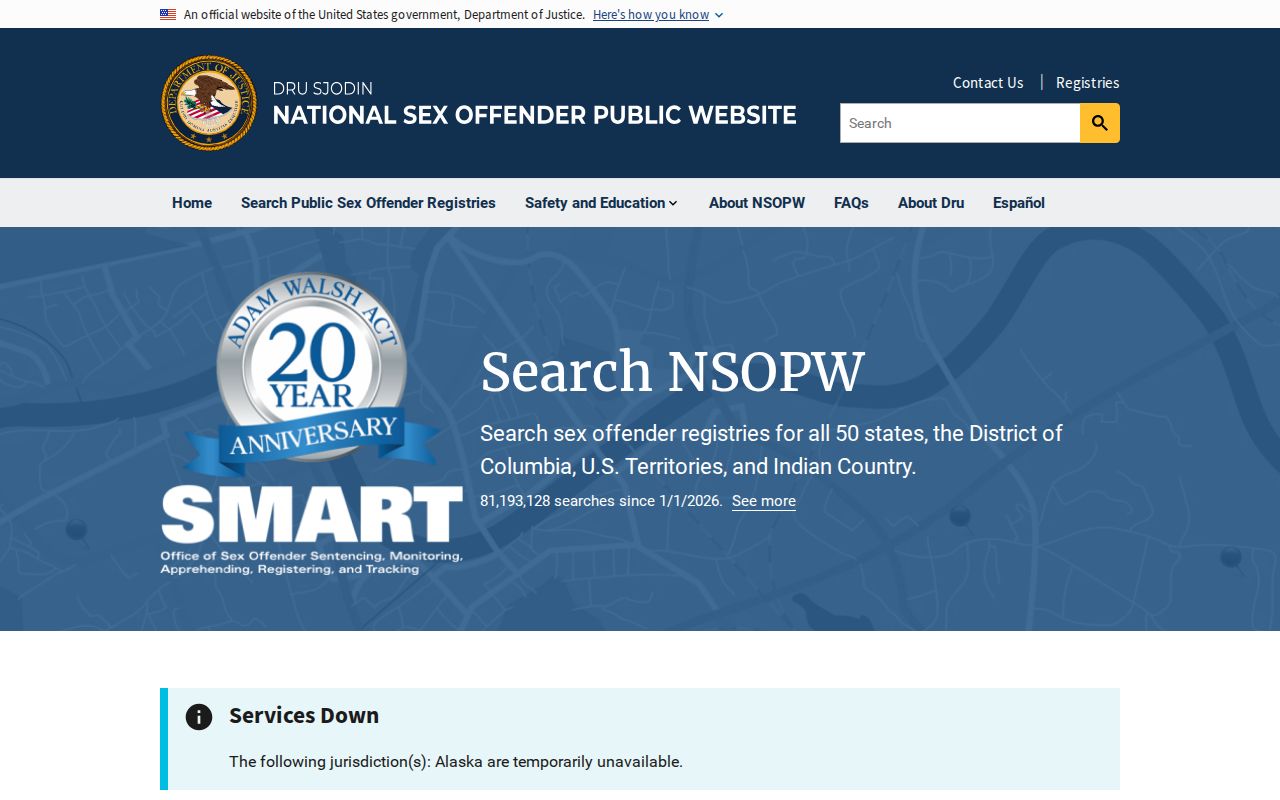
That national view helps address searches near the border without relying on an unofficial people-search service.
Results from two official systems can differ because each state supplies its own data and update schedule. Compare the name, photograph, reported location, and conviction facts. If NSOPW points back to Georgia, the GBI page is the controlling public Georgia profile. If it points to another jurisdiction, use that jurisdiction's registry and contact authority for verification.
Inside a Hart County Registry Profile
A Hart County registry profile combines identity clues, a reported location, verification details, classification fields, and conviction information. Read each field literally. “Absconder” is a status, “Predator” is a separate designation, and “Not Leveled” does not mean low risk.
| Name and Aliases | First, middle, last, suffix, and published alternate names |
|---|---|
| Photo and Description | Current photograph date, gender, race, birth year, height, weight, hair, and eyes |
| Reported Location | Primary or last-known address and county, or incarcerated status |
| Offense | Count, conviction date, conviction state, and offense name |
| Classification | Level I, Level II, Not Leveled, and separate Predator yes/no field |
| Registration Status | Registration date, residence-verification date, and Absconder yes/no field |
Some details were not present on the public profiles inspected for Hart County research. Vehicle data, an employer or school, scars and tattoos, victim age, and a statute code should not be promised as standard fields. Their absence is also not proof that an agency lacks the data. It means only that the inspected public display did not show it.
Hart County Registry Update Timing
Georgia sheriffs must send registry changes to GBI within two business days, and GBI states that the public registry updates daily. Those two clocks explain why a very recent move may need direct confirmation even when the online profile has not changed yet.
Registrants generally report qualifying changes within 72 hours. They also renew in person during the 72 hours before their birthday each year, when the sheriff updates the photograph and fingerprints. A sexually dangerous predator has an added six-month verification requirement. Suspected noncompliance should be reported to the sheriff or GBI, never investigated through confrontation.
Timing should guide how a search is read. A profile can be accurate as of its last verification date yet still be waiting for a newly reported change. The sheriff's two-business-day reporting duty and GBI's daily update practice reduce delay, but neither makes the public display instantaneous. A direct question to the Hart County office is the safest fallback for a very recent move.
The GBI's official sex offender registry FAQ documents Georgia's registration, update, eligibility, and duration rules.
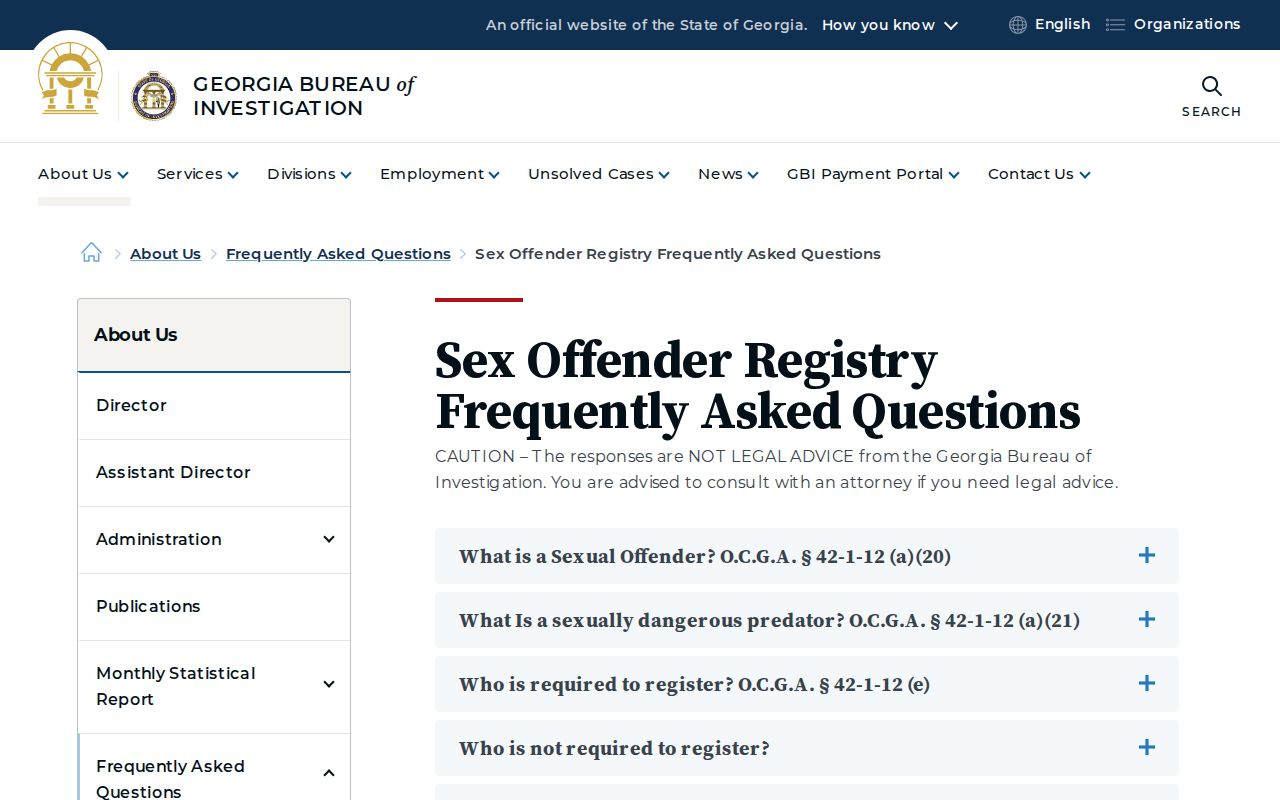
That agency guidance supplies the needed context when a Hart County profile or renewal date cannot be understood from the search result alone.
Note: Save the date and time of a Hart County search because a registry profile can change after local verification reaches GBI.
Georgia Registration Levels and Requirements
Georgia does not use federal ten-year, twenty-five-year, and lifetime tiers as its public labels. The Sexual Offender Registration Review Board assigns risk classifications, while registration is generally for life. Removal under O.C.G.A. §42-1-19 requires a fact-specific court petition and statutory eligibility; a risk level alone does not create a fixed shorter term.
| Level / Tier | Duration | Verification Frequency |
|---|---|---|
| Level I | Generally lifetime | Annual birthday renewal; qualifying changes within statutory windows |
| Level II | Generally lifetime | Annual birthday renewal; qualifying changes within statutory windows |
| Sexually Dangerous Predator | Generally lifetime | Annual renewal plus six-month verification |
| Not Leveled | Generally lifetime | Annual renewal; not a low-risk label |
Juveniles are not registered merely because of a juvenile adjudication; Georgia's research source says registration applies when a juvenile is tried and convicted as an adult. Removal is also not automatic after a set period. A petition may require completion of confinement, parole, supervision, and probation, plus a qualifying statutory category. The court evaluates the individual filing.
Read Hart County Registry Labels Carefully
Several registry terms answer different questions. Level I and Level II describe assessed risk. Sexually Dangerous Predator is a distinct high-risk classification. Absconder describes a reported compliance status. None of those labels proves new criminal conduct, and the offense table should not be expanded into assumptions about victims or current behavior.
Georgia profiles publish a year of birth rather than a full date of birth. Match aliases, physical details, address, photograph date, and offense facts before concluding that a result concerns the person sought. For a possible error, the GBI conditions direct questions to the sheriff responsible for the record.
The offense table reflects conviction information that supports registration. It does not disclose every fact in the underlying court file and cannot establish present conduct. The residence-verification date answers when that address was checked, not whether someone was at the address at the instant of the search. Those limits matter when using Hart County registry data for a practical safety plan.
Report Hart County Compliance Concerns
If a profile appears to show an outdated address or suspected noncompliance, contact the Hart County Sheriff's Office at 890 Vickery Street, Hartwell, GA 30643, or 706-376-3114. Give the profile details and the specific concern. Let trained law enforcement check the report.
Do not approach the person or household. A public registry is meant to support safety planning and informed awareness. It is not a warrant list, a current-offense report, or permission for private enforcement.
Give law enforcement a focused report: the profile name, reported address, date viewed, and the fact that appears inconsistent. Avoid posting an accusation or spreading an unverified claim. Hart County deputies and GBI have the authority and access needed to determine whether a reporting duty was missed, whether an update is pending, or whether the public reader misunderstood a field.
Community Notification and Lawful Use
Use Hart County registry information for personal, family, and community safety. Verify key facts through the GBI record and the sheriff before relying on them. O.C.G.A. §42-1-12 governs Georgia's registry and reporting framework, while the portal conditions warn that misuse causing injury, harassment, or another crime can bring civil or criminal consequences.
Community awareness can include checking an address before a visit, reviewing a neighborhood with family, or confirming the correct official contact when a profile raises concern. It should stay tied to safety facts. A classification is not a license to infer unlisted victim details, claim a new crime occurred, or contact a registrant. Use the official reporting channel and let the responsible agency act.
Use registry data lawfully: Georgia registry information must not be used to harass, threaten, intimidate, or harm a listed person or household. Misuse may violate O.C.G.A. §42-1-12 and other civil or criminal laws.